

Sunday, October 11, 2026 · No. 4 · WychBourne Village
The Front Page
When the puppet looks back
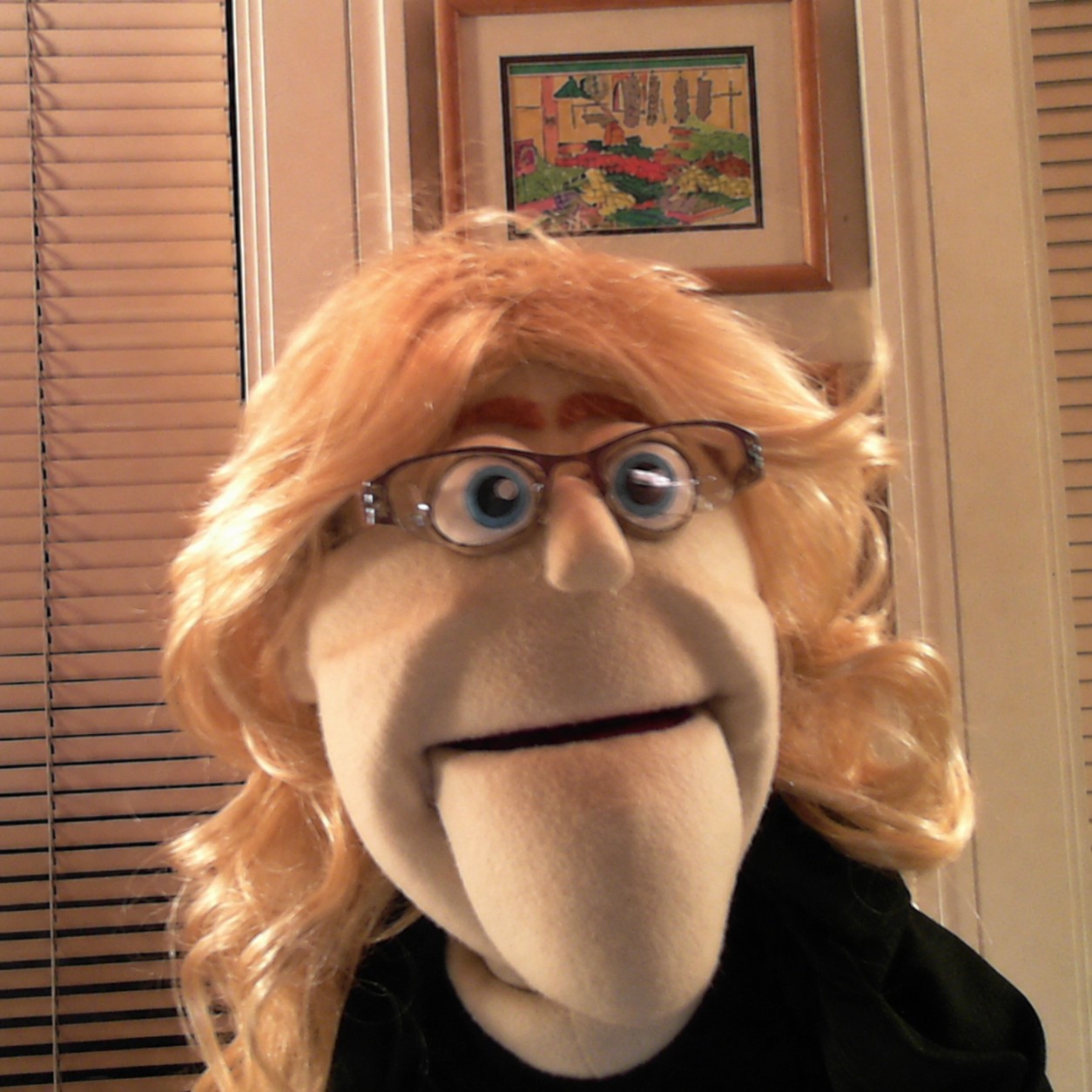
Dev and Kai did not take long to find their voices at Sooke Library on Friday. Four soon-to-be puppeteers joined us for two hours of introductions, stories and imaginative play, with the ever-ready puppet hug waiting in the wings.
I never tire of watching hesitation give way to play. Sometimes it happens in minutes. For others, the doorway takes a little longer to find. Many of us carry old messages: don’t be silly, you look awkward, you are too clumsy. Those messages can arrive in the room before we do.
After several Meet the Puppets! sessions, I want to offer a few words to anyone wondering whether they could do this.
There is a moment when you put a puppet on your arm and look at them. Allow a small suspension of disbelief, and suddenly they seem to look back: I am here. They have taken the magic bus from their world to ours—and opened a door through which we can visit theirs.
I often notice a kinship between this absorbed attention and self-hypnosis: imagination, focus and a willingness to “act as if” all have a part. Puppet play need not be a formal hypnosis exercise to be absorbing. Nor does that first spark have to arrive on command. Familiarity and practice can help us find our own way into it.
Try this at your next visit: before picking up a puppet, pretend you are meeting a person. Pause. Introduce yourself. Give them a moment to answer in your imagination. You may notice a change in how you approach one another.
Our Common Thread puppets are substantial companions. They wear clothes sized for a two-year-old, with heads larger still. Move as though you were cradling an eighteen-month-old child: support the head, slow down and handle them gently. A small, considered movement can say a great deal.
A room of strangers, instructions and unfamiliar equipment can also feel like too much. If you find yourself freezing, going quiet or wanting to leave, you owe nobody a performance or an explanation. Watching is participation, too.
For a quieter beginning, join as a Community Puppeteer and book Studio Hours. There are several practice rooms, space to settle and time to sit with a puppet at your own pace. The door will still be there when you are ready.
Around the Village
A weekend for making things happen
Our third-weekend gatherings begin with the members’ meeting on Thursday, October 15, at 4 p.m. Pacific on Zoom. This is a chance to talk with the Troupe Guide about the business of our shared programme: how we organize, what we need and what we are willing to take on together. Join the members’ Zoom meeting.
The co-op exists to help bring about systemic change. The arts programme is central to that work, and it belongs within a wider vision of community wellness. We need members to step forward and help get the troupe launched. Whatever you hope to do in puppetry or community wellness, we can make more progress toward our individual goals by collaborating.
- Friday, October 16, 2–7 p.m.: GreenScreen Theatre.
- Saturday, October 17: GreenScreen Theatre, 9 a.m.–noon; Wigs, Bling and Things, 1–4 p.m. We will also spend time organizing the café-skit props.
- Sunday, October 18, 11 a.m.–4 p.m.: Living Character Circle.
I divided Studio Hours into different segments to give us a starting shape. While participation is still building, those labels may be more useful as suggestions than as firm divisions. Most of these activities need several people. What matters most is getting puppets on our arms, working through a skit together—and taking a picture of it. We can shape the work around the people who come.
Wanted: our Master Bard/Engineer
Perhaps your favourite place is behind the camera. We need someone who is more interested in recording the puppets than operating them: a person who enjoys finding the shot, catching the exchange and helping a scene become something we can share.
We have plenty of gear. Our Green Screen studio is simple, but it offers the essentials: control of the lighting and enough space to record a larger ensemble. What we need now is the person who wants to put those possibilities to work with us.
I will keep returning to this invitation. If it sounds like you—or someone you know—come along to Studio Hours or get in touch with the Troupe Guide. Helping the puppets be seen is an important part of bringing them to life.
Sessions are at Manzer Commons. Sign in to see Studio Hours and RSVP. Bring your curiosity, your questions and whatever amount of practice you can manage.
Around Manzer Commons
A permanent home for the work we share
With local election day on Saturday, October 17, we plan to send all candidates a brief introduction to Manzer Commons Cooperative and ask for their support. The intention remains a lasting neighbourhood community and resource centre, with a home for our troupe and the wider work we share.
Watch for a separate message this week with ways to reach candidates and say why this matters to you. A permanent place grows out of many people being willing to speak for it. Your own reasons, in your own words, are a good place to begin.
Your Two Cents
Who is responsible for the missing biscuit?
A plate of biscuits arrives at rehearsal. Five minutes later, one remains. Every puppet has an innocent expression, which is convenient because several were built that way.
Does the last biscuit belong to the person who brought them, the person who makes the tea, or whoever can invent the most convincing alibi? Bring your ruling—and any suspicious crumbs—to Freyja’s Café.
The Tau Medicine Garden
Lavender: the fragrance in the linen drawer


A little bag of dried lavender can carry the memory of an entire garden into a cupboard. Its violet flower spikes belong as much to household history as to the herb bed.
In A Modern Herbal (1931), Maud Grieve describes lavender grown for perfume, dried sachets and pot-pourri. She also records the lavender fields around Mitcham in Surrey, increasingly displaced as London expanded. A familiar fragrance turns out to have a history of fields, harvests and changing neighbourhoods behind it.
Grieve’s account places lavender among traditional herbs used for digestive discomfort, nervous headaches and weariness. Her entry gathers older herbalists’ beliefs alongside the practices of her own time. These are accounts of herbal tradition rather than treatment advice.
A Moment of Practice
Let the words have a voice
Last week we introduced the Gokai, the five Reiki precepts. Understanding their meaning matters. In the Japanese Reiki practice we are exploring, so does learning to speak them in Japanese.
Listen to Mari Okazaki recite the Gokai in Japanese. Listen to a line, then repeat it gently. Give the sounds time to become familiar.
Kotodama, also called kototama, is often translated as “word spirit”: the spiritual potency understood to reside in words and their utterance. It belongs to Japanese traditions that recognize spiritual presence in the world around us, including sound. This is a cultural and spiritual understanding, rather than a belief held identically by every Japanese person. The familiar Western ideas of a blessing or a curse offer one way to approach it: words can carry intention as well as information.
Make room for the Gokai at least twice each day, on waking and before bed. Reciting them aloud, with attention to their meaning, is a core practice in Japanese Reiki. If you intend to practise this art, here is a place to begin: a few words, given your voice, morning and evening.
Further reading: Gokai and kototama; morning and evening recitation.
The Study Table
A box to practise with, a book to play from
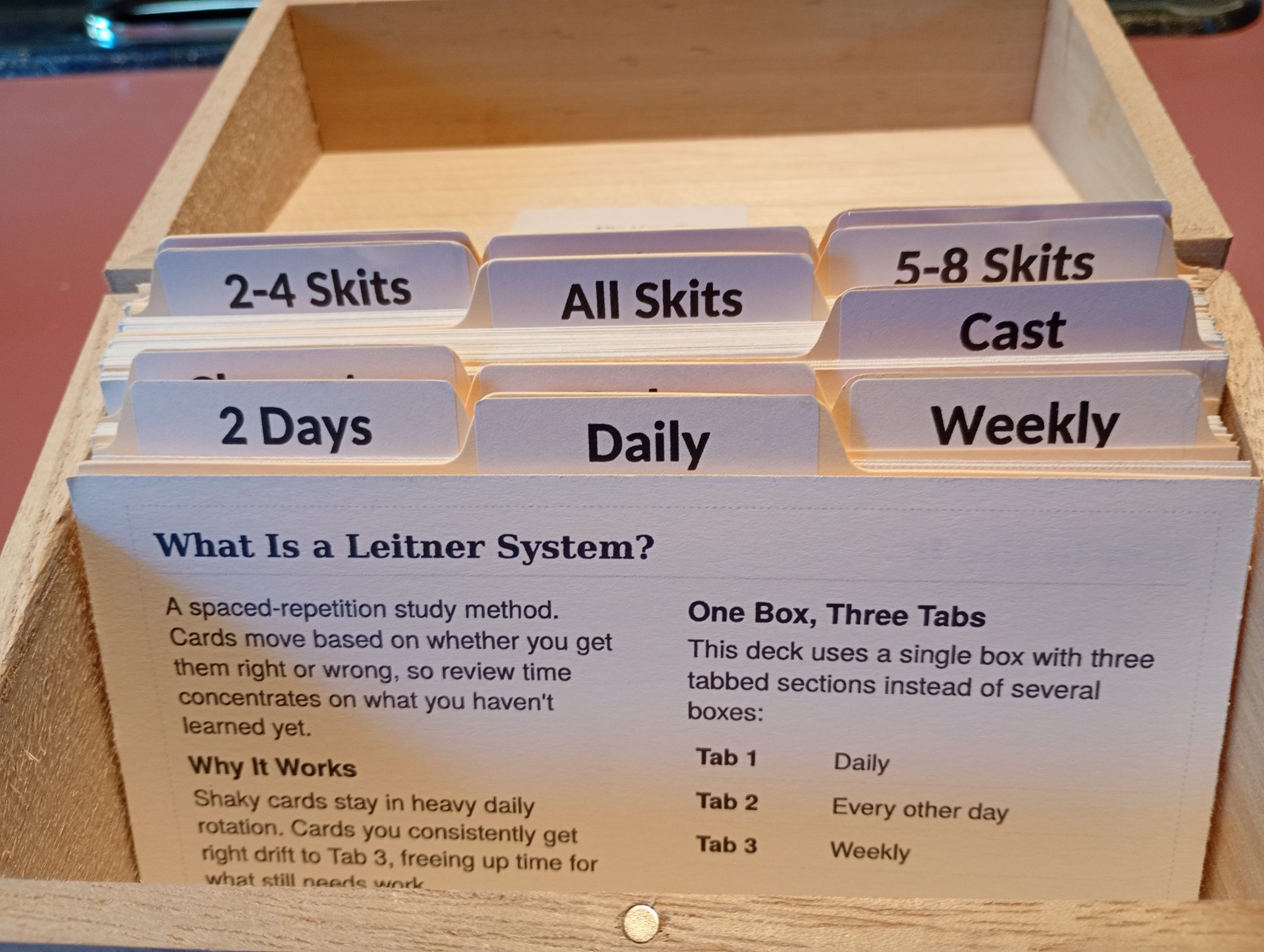
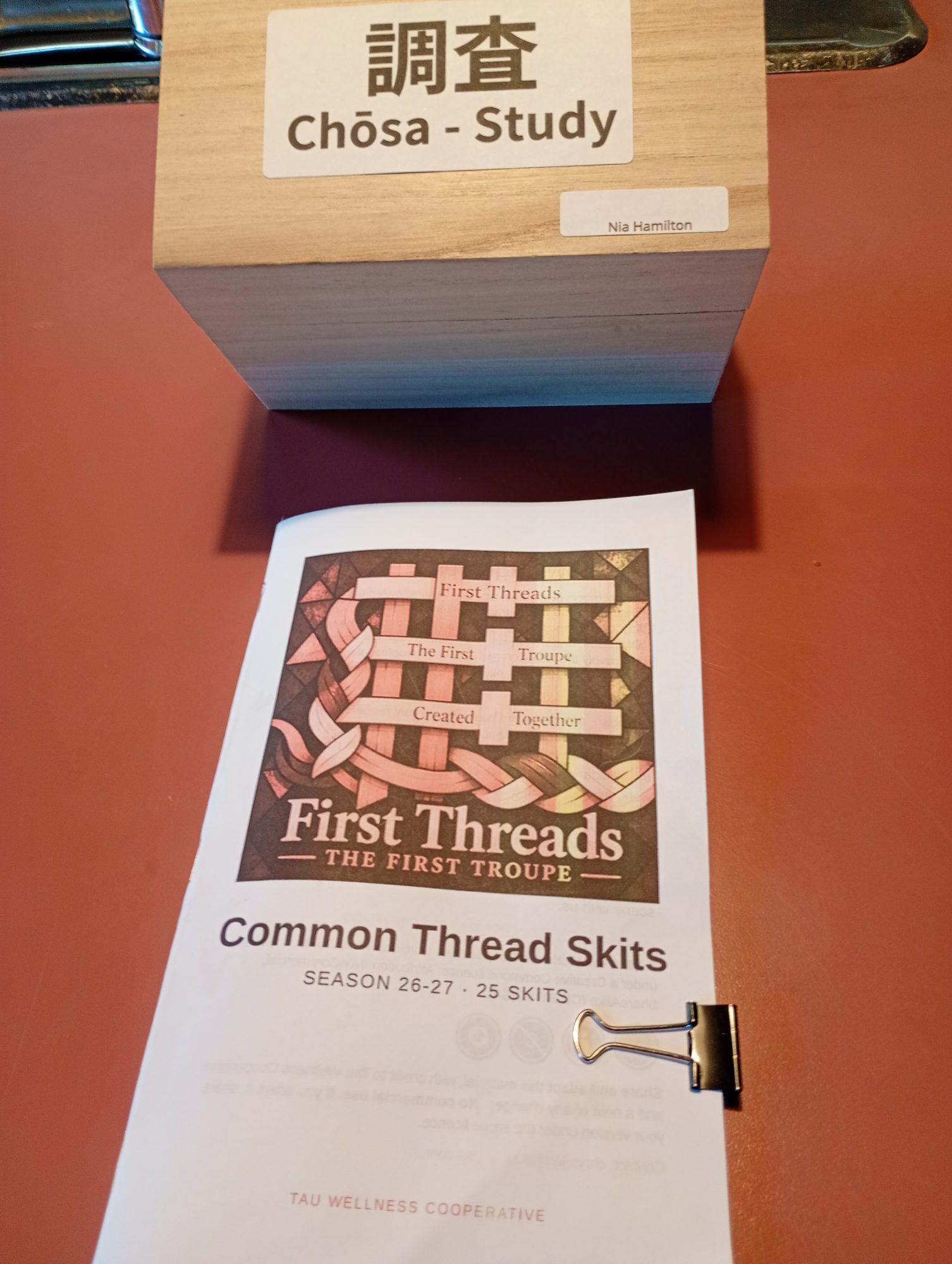
The Chōsa boxes were organized in time for Sooke’s Meet the Puppets! It was a pleasure to show newcomers that all this learning has a home: the things shared with other performing arts, and the extra things puppetry asks of us.
Daily, every-other-day and weekly tabs help you return to the cards that need attention. Try saying an answer before turning the card over. Knowing your part means being able to restate what you have learned; for the best recall scores, practise until you can recite the wording verbatim.
New materials will be added to the Resources tab in your membership profile. Releases stay grouped by month, with September and October separate, while the cards themselves increasingly find their places as Character, Skit, Business and Prop cards.
The other arrival is the official First Threads skitbook. We will use paper copies while we try and refine the scenes, before making digital copies available. Pick up your copy at Studio Hours or a Troupe Workshop.
Those who have been around the co-op awhile know my fondness for making these little informal books. The first working copy still takes thirty to forty hours. What has changed is how I spend those hours, with more capable editing tools at my fingertips. The best part remains putting a book into somebody’s hands and finding out what we can make of it together.
The Weekly Mind Twister
Before the curtain
Three puppets enter one at a time: Dev, Kai and Nia. Dev enters before Kai. Nia enters after Dev but before Kai. Who comes on first, second and third?
Open the answer when you’re ready
Dev, Nia, Kai. Nia fits between the other two. Now all three are on stage; whether anyone remembered the teapot is another question.
From the Troupe Guide
More than one way to read the world
During fifty years in construction, I worked alongside people whose abilities were not always well recognized in a classroom. Some had “ended up” in the trades after finding school a poor fit. Those same people went on to prove themselves as leaders and stars in their trades. Their ability to see problems differently helped them arrive at novel, often cost-effective solutions—and cost is so often what drives a decision on a worksite.
Try operating a large excavator for five minutes and you may gain a new appreciation for someone who does it all day: judging space, weight, distance and movement almost as another language.
Many of us who are neurodivergent encounter literacy differently from what is statistically common. That can bring particular strengths as well as difficulties, and no two people have the same combination. I see a similar range of ways of learning among creative people.
I want our puppetry programme to make room for that range. Cards, conversation, pictures, demonstration, repetition and time with a puppet offer different ways in. We will keep learning which approaches help, and changing what gets in the way.
Keeping that evolving practice of inclusion at the centre of my work is my promise to you.